Development of the World’s Only PFAS Removal Method Pressure Flotation
Current Status
They have adverse effects on human health, with concerns over carcinogenic potential and developmental delays in infants and fetuses.
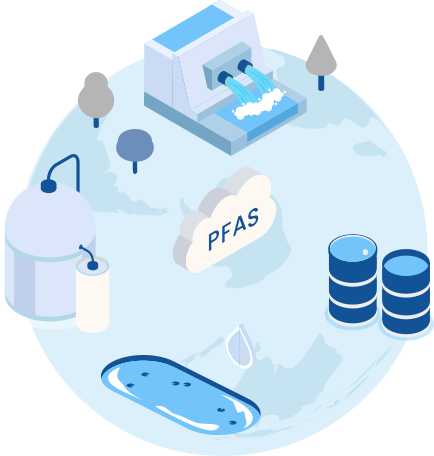
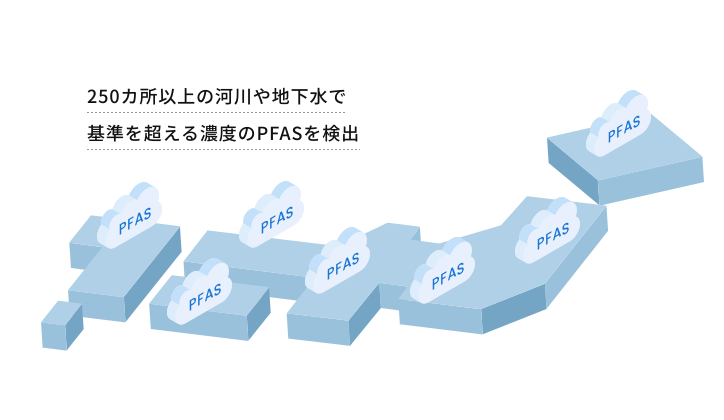
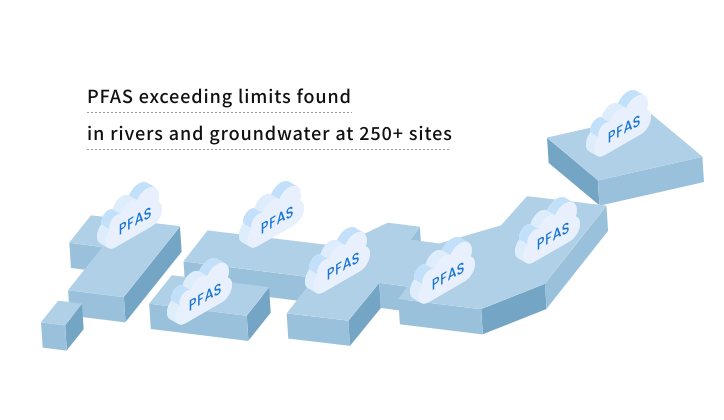
PFAS are a group of chemicals known as “forever chemicals.” They have harmful effects on the human body, raising concerns about carcinogenic potential and developmental issues in infants and fetuses. Since they can be ingested daily through tap water and groundwater, urgent countermeasures are required. In Japan, the national provisional standard is set at 50 ng/L, yet concentrations exceeding this value have already been detected in over 250 rivers and groundwater sites. In contrast, the U.S. has established a far stricter limit of 4 ng/L, and international regulations on PFAS are expected to become increasingly stringent. Given this situation, the introduction of more effective PFAS removal technologies is essential.
What’s about
This device effectively separates and removes high concentrations of PFAS.
The pressurized flotation separation system generates ultra-fine microbubbles to effectively separate and remove high concentrations of PFAS. By utilizing the flotation effect of microbubbles, PFAS can be efficiently recovered, making it possible to treat large volumes of highly contaminated water that conventional methods cannot handle. While PFAS removal methods include activated carbon adsorption and membrane treatment, our company was the first in the world to commercialize PFAS removal using pressurized flotation separation. This technology is characterized by its ability to efficiently separate large volumes of high-concentration PFAS while keeping operating costs low.
Please note: audio may play.

Comparison
Superior to Activated Carbon in Processing Capacity and Operating Cost
PFAS treatment has two important characteristics: it requires handling of large volumes and long-term processes. Since it targets groundwater and rivers, the treatment volume is enormous, and long-term measures are required to address pollution sources such as chemical plants and industrial waste facilities. Considering these factors, ideal PFAS treatment must allow large-scale processing and low operating costs. While activated carbon systems have traditionally been used, pressurized flotation separation offers advantages in both processing volume and operational cost, making it a superior technology for PFAS treatment.

Scroll Horizontally

Capable of achieving levels below regulatory standards.

Capable of continuous large-scale processing.
Equipment costs incurred.
Usable at less than 30% of the size of activated carbon systems.
Can be operated at less than 50% of the size.

Capable of achieving levels below regulatory standards.

Dependent on the amount of activated carbon and contact time.
Equipment costs incurred.
Frequent replacement of activated carbon is required due to clogging.

Treating PFAS-contaminated water requires a large site.
Note 1: Calculated at the same processing capacity
Feature

Removal of Large Amounts of PFAS
PFAS concentrations hundreds of times higher than the national provisional standard can be separated and removed using the pressurized flotation separation system (performance record: average removal rate exceeding 90%).
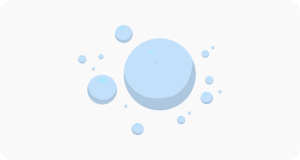
Generation of Microbubbles
By generating bubbles 1/100 the size of those in conventional flotation systems, it becomes possible to remove harmful chemical substances.
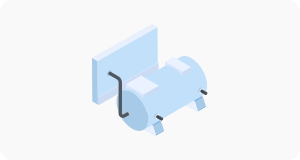
Capable of treating a wide range of hazardous substances.
Capable of removing hazardous substances that are difficult to treat with conventional flotation separation, including oils, paints, and specialized chemicals.
Flow

Contaminated water and reagents are mixed in a PFAS-capturing reaction tank and transferred to the pressurized flotation separation tank.

Very fine bubbles, generated through repeated pressurization and depressurization by a pressurized water tank and pump, are transferred to the flotation separation tank.
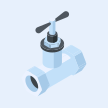
In the pressurized flotation separation tank, PFAS contained in contaminated water adheres to bubbles and rises to the surface.

By collecting the PFAS that has floated to the surface with flotation froth, PFAS is separated from the water in contaminated wastewater.

Recovered PFAS is rendered harmless using the subcritical water treatment system.
Achievement
Demonstration Experiment: PFAS Removal Using Pressurized Flotation Separation System
We are conducting demonstration experiments with the City of Shizuoka to remove PFAS contamination. Furthermore, we have signed a partnership agreement aimed at advancing research and practical implementation of PFAS removal technologies using our Subcritical Water Integrated System, promoting Shizuoka as a leading SDGs environmental city, and contributing to solving global environmental issues through the system’s application.
Note: A Holdings = Our Parent Company
Spec
Customization is possible depending on the amount of PFAS to be treated and the facility space.
Scroll Horizontally
Small Scale
Medium Scale
Large Scale
Note 1: Classified by multiple factors such as equipment size and processing capacity
FAQ
Please tell us which PFAS types have been confirmed for removal, the raw water concentrations, and the removal efficiency.
We have proven removal performance mainly for PFOS and PFOA. Raw water concentrations have ranged from 12,000 ng/L to 1,000 ng/L, with removal efficiencies of over 95% for both PFOS and PFOA.
Can this system be applied to wastewater from factories using PFAS?
It can be applied in a wide range of cases. We provide optimal solutions even when there are many impurities, when raw water concentrations are high, when temperatures are elevated, or when pH levels fluctuate significantly.
How long does it take from installation to the start of operation?
From contract to operation, it generally takes about 7–9 months. This includes design, manufacturing, installation, test runs, adjustments, and operational training. The timeframe may vary depending on existing facilities and the characteristics of the waste, but our project managers thoroughly manage the schedule to ensure operations start as planned.
What Is the Subcritical Water Integrated System?
The Subcritical Water Integrated System is a comprehensive solution consisting mainly of subcritical water treatment equipment, pressurized flotation separation systems, and various fermentation devices. By utilizing this system, it is possible not only to achieve zero-CO₂ industrial waste treatment but also to neutralize hazardous chemical substances such as PFAS.